

Choosing the right omega 3 fatty acid supplement matters because these products directly affect your dog's skin, coat, joints, and overall inflammation levels. The correct formulation and dose help maintain mobility and reduce flaky skin or shedding without adding unnecessary ingredients. This guide shortlists seven top-rated omega 3 fatty acid supplements for dogs and explains the evaluation criteria we used, including purity, EPA/DHA concentration, and dosing accuracy. Use these picks and the buying advice that follows to match a supplement to your dog's size, life stage, and specific health concerns.
Top Picks at a Glance
| Best Overall Omega 3 Fatty Acid Supplement The best all-around choice for most dog owners' needs | Nordic Naturals Omega-3 Fish Oil 180 Ct |  |
| Best Budget Omega 3 Fatty Acid Supplement A low-cost option that still delivers basic omega-3 benefits | Amazon Basics Wild Alaskan Salmon Oil 8 fl oz |  |
| Best Premium Omega 3 Fatty Acid Supplement A higher-end option with superior sourcing and processing standards | Vital Pet Life Fish Oil 64 oz |  |
| Best Concentrated Omega 3 Fatty Acid Supplement Higher-potency formulas that deliver more EPA/DHA per serving | NuLife Pure Omega 3 Fish Oil 180ct |  |
| Best Liquid Omega 3 Fatty Acid Supplement A pourable oil format for flexible dosing and mixing | Natural Dog Company Wild Alaskan Salmon Oil 16 oz |  |
| Best Chewable Omega 3 Fatty Acid Supplement Palatable chew or soft-gel treats that dogs willingly eat | Nutramax Welactin Soft Chews 60ct |  |
| Best Sustainably Sourced Omega 3 Fatty Acid Supplement Options emphasizing eco-friendly sourcing and responsible fisheries | LEGITPET Wild Alaskan Salmon Oil 32 oz |  |
Nordic Naturals Omega-3 Fish Oil 180 Ct
Best Overall Omega 3 Fatty Acid Supplement

| Item Form | Soft Gel |
|---|---|
| Active Ingredients | Eicosapentaenoic Acid, Docosahexaenoic Acid |
| Flavor | Unflavored |
| Unit Count | 180 Count |
Nordic Naturals Omega-3 Pet soft gels deliver concentrated EPA and DHA in an easy-to-give capsule designed for medium to large dogs or for mixing into food for smaller pets. Each soft gel provides 165 mg EPA and 330 mg DHA per capsule, which the brand positions as a triglyceride-form fish oil for better absorption and minimal fishy aftertaste. In practice these soft gels are convenient for daily supplementation: larger dogs can swallow the capsules whole, while owners of smaller or picky pets can puncture a gel and squeeze the oil onto food. The product emphasizes purity and sourcing from anchovies, sardines, mackerel, and herring with no artificial flavors, common allergens, or unnecessary additives. Dosing guidance is simple (one soft gel per 20 lbs), so achieving a higher omega-3 intake with fewer pills is straightforward. The main limitations are the soft-gel format for very small dogs or cats that may require liquid or mini-gels and that potency per gel may still require multiple capsules for very large breeds with high EPA/DHA needs.
Best for: Buyers who want a higher EPA/DHA dose in a compact, easy-to-administer form for routine daily supplementation and who prefer a purified, human-grade sourcing approach for their pet.
Less Ideal for: Owners seeking tiny chewable doses or liquid formulas for very small or pill-averse pets should consider liquid or mini-gel alternatives instead.
- Concentrated EPA+DHA per soft gel (165 mg EPA + 330 mg DHA) for easier dosing
- Triglyceride-form fish oil for improved absorption and reduced fishy aftertaste
- Clear dosing guidance (one soft gel per 20 lbs) simplifies daily use
- Formulated without common allergens and without artificial colors or flavors
- Large unit count (180 soft gels) reduces refill frequency
- Soft-gel size and format may be hard to dose for very small dogs or cats
- May require multiple capsules for extremely large dogs to reach very high EPA/DHA targets
Verdict: The best overall omega 3 fatty acid supplement balances dosage, purity, palatability, and price to suit most dogs and everyday health goals.
Amazon Basics Wild Alaskan Salmon Oil 8 fl oz
Best Budget Omega 3 Fatty Acid Supplement

| Volume | 8 fluid ounces |
|---|---|
| Flavor | Salmon |
| Item Form | Oil |
| Target Species | Dog, Cat |
This Wild Alaskan Salmon Oil is a straightforward liquid omega-3 supplement meant to be added to a pet's food daily. Packaged as a single-ingredient salmon oil, it supplies EPA and DHA to support skin and coat health, reduce shedding, and contribute to joint and brain function. Use is simple: pump the recommended amount over wet or dry food based on body weight and refrigerate after opening to preserve freshness. The product's strengths are its ingredient simplicity and broad applicability for both dogs and cats of all ages, and the 8 fl oz size is convenient for trialing or routine use. Expect practical benefits like a shinier coat and potentially reduced inflammation when used consistently. Limitations are that the listing does not provide an explicit EPA/DHA concentration per pump and the oil must be refrigerated and used within about 90 days after opening, which could be a consideration for very large households or irregular use. For buyers prioritizing a no-frills, single-ingredient fish oil at an accessible price, this covers the basics reliably.
Best for: Pet owners who want an affordable, no-frills omega-3 supplement to add essential EPA/DHA to their dog or cat's diet without paying for extras or complex formulas.
Less Ideal for: Owners who need precise EPA/DHA dosing information for therapeutic uses or large-breed households that will go through the bottle slowly should consider veterinary-grade concentrates with clear potency labeling.
- Single-ingredient Wild Alaskan salmon oil for clean, simple supplementation
- Suitable for both dogs and cats across life stages
- Easy to add to wet or dry food with pump dosing
- Supports skin, coat, joint, and brain health through EPA/DHA
- Reputable brand positioning with straightforward storage instructions
- No stated EPA/DHA concentration or per-pump dosing details on the product page
- Requires refrigeration after opening and recommended use within 90 days
Verdict: The best budget omega 3 fatty acid supplement gives reliable EPA/DHA support at a lower price while maintaining acceptable purity and efficacy for routine use.
Vital Pet Life Fish Oil 64 oz
Best Premium Omega 3 Fatty Acid Supplement

| Item Form | Oil |
|---|---|
| Active Ingredients | Pollock Oil, Salmon Oil |
| Volume | 64 fluid ounces |
| Dog Breed Size | All |
| Product Benefits | Digestive Health, Heart Health, Immune Support, Joint Health, Skin Care |
This liquid fish oil from Vital Pet Life is a large-format omega supplement intended as a daily food topper to support skin, coat, joints, heart, and immune health. It comes with a twist-open pump for easy, no-mess dosing directly onto food and lists pollock and salmon oil as the active ingredients, supplying EPA and DHA. Practical benefits include a high-volume bottle for multi-pet households or long-term use, NASC membership formulation standards, third-party species verification, and MSC sustainable sourcing claims that fit someone who prioritizes traceability and purity. The formula is versatile for dogs, cats, ferrets, and other pets and includes dosing guidance by weight. Limitations are that concentration per serving (EPA/DHA mg) is not stated in the visible specs, so buyers seeking a highly concentrated, measured omega profile may need to contact the brand or compare lab results, and the large bottle can oxidize if not stored or used within recommended timeframes once opened.
Best for: Buyers who value premium sourcing, independent verification, and a high-volume, easy-dosing omega supplement for multiple pets or long-term use.
Less Ideal for: Owners who need a precisely quantified, high-concentration EPA/DHA per dose or those who prefer individual-dose formats like capsules or smaller bottles.
- Large 64 fl oz volume suitable for multi-pet homes or long-term supplementation
- Contains both pollock and salmon oil providing EPA and DHA omega-3s
- No-mess pump dispenser for easy dosing onto food
- NASC-aligned formulation and independent third-party species verification for sourcing transparency
- MSC certification for sustainable sourcing
- Label does not list EPA/DHA milligram concentration per serving in available specs
- Large liquid bottle requires careful storage and use to avoid oxidation after opening
Verdict: The best premium omega 3 fatty acid supplement is for owners willing to invest in superior extraction, higher purity, and extra testing for maximum quality and long-term confidence.
NuLife Pure Omega 3 Fish Oil 180ct
Best Concentrated Omega 3 Fatty Acid Supplement

| Unit Count | 180 Count |
|---|---|
| Item Form | Soft Gel |
| Active Ingredients | Wild Caught Fish From Iceland |
| Flavor | Wild Caught Sardines, Herring, Mackerel & Anchovy |
NuLife Pure Omega 3 is a concentrated softgel supplement made from wild-caught anchovy, sardine, herring, and mackerel that delivers EPA and DHA to support coat, joint, and heart health. Each softgel provides 180 mg EPA and 120 mg DHA and is designed to be given whole to larger dogs or pierced and squeezed over food for small dogs, making dosing flexible. The product emphasizes purity with molecular distillation, human-grade ingredients, and sourcing from Icelandic fish, which lowers the risk of heavy metals and a strong fishy odor compared with some liquids. In practice the softgels are low-mess and convenient for daily use, and the 180-count bottle gives a long supply for most households. Limitations include the need to pierce or hide the 1-inch capsule for very small mouths and that the formula and dosing are tailored for dogs rather than cats, so a veterinary check is sensible for animals on medications or with special needs. For owners seeking a high-EPA/DHA softgel from wild-caught sources, this is a practical, concentrated option.
Best for: Buyers who need a potent EPA/DHA boost in a compact daily dose and prefer a low-mess softgel made from wild-caught sources.
Less Ideal for: Owners wanting liquid fish oil for easy mixing into multiple meals or those who need a cat-formulated omega-3 product should look elsewhere.
- High per-capsule EPA (180 mg) and DHA (120 mg) concentration for stronger omega-3 dosing
- Made from wild-caught Icelandic fish and molecularly distilled for reduced heavy metals
- Softgel form is low-odor and low-mess compared with liquid alternatives
- Large 180-count supply reduces refill frequency
- Softgel size may be large for very small dogs and often needs piercing or hiding in food
- Formulation and dosing are dog-specific and not set for cats
Verdict: The best concentrated omega 3 fatty acid supplement suits dogs needing higher EPA/DHA intake in smaller volumes, offering a stronger dose per serving with clear labeling.
Natural Dog Company Wild Alaskan Salmon Oil 16 oz
Best Liquid Omega 3 Fatty Acid Supplement

| Volume | 16 fluid ounces |
|---|---|
| Item Form | Oil |
| Active Ingredients | EPA, DHA, OMEGA-3, OMEGA-6 |
| Flavor | Wild Alaskan Salmon Oil |
This Wild Alaskan Salmon Oil is a straightforward liquid omega-3 supplement designed to be pumped onto food or given directly, making daily dosing simple for most households. The formula blends wild-caught salmon and pollock oils to deliver EPA and DHA plus minor tocopherol preservative, which translates to easier absorption than many pill forms and a palatable food topper for picky eaters. Typical use is one to three pumps per day based on dog weight, so it fits into meal routines and can be increased or decreased without measuring spoons. Practical benefits include noticeable coat shine and reduced flakiness for many dogs, plus supplemental support for joints and cardiovascular health thanks to concentrated omega fatty acids. The bottle includes a pump for clean dosing, but because it is a pure oil there is no added vitamin complex or guaranteed EPA/DHA concentration on the label, so precision dosing by fatty-acid content is not possible from the packaging alone. Owners should introduce it gradually and consult their veterinarian if their dog is on blood-thinning medication or has a specific health condition.
Best for: Owners who want a flexible, easy-to-administer omega-3 they can mix into meals or give directly and who prioritize a liquid topper over pills or chews.
Less Ideal for: People looking for exact EPA/DHA milligram dosing per serving or a supplement with added vitamins, minerals, or joint-specific ingredients.
- Liquid pump format makes dosing into food quick and flexible
- Blend of wild-caught salmon and pollock provides naturally occurring EPA and DHA
- Supports skin and coat health and can improve coat shine and reduce flakiness
- Useful across life stages and breed sizes with simple weight-based pump directions
- Label does not provide specific EPA/DHA concentrations for precision dosing
- Pure oil can be messy and may stain if spilled
Verdict: The best liquid omega 3 fatty acid supplement is ideal for owners who prefer adjustable dosing and easy mixing into food, with minimal fishy aftertaste and reliable stability.
Nutramax Welactin Soft Chews 60ct
Best Chewable Omega 3 Fatty Acid Supplement
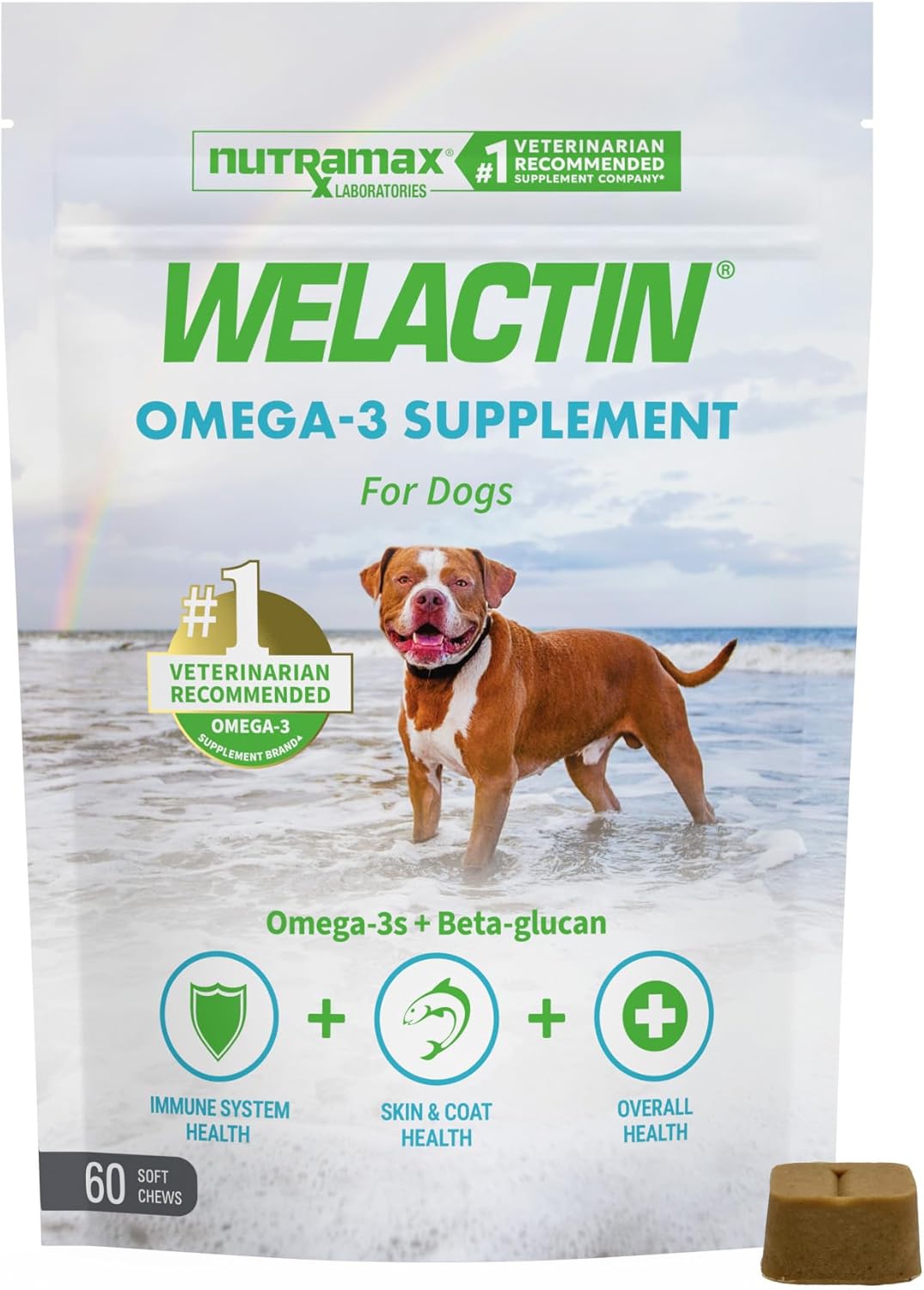
| Item Form | Soft Chew |
|---|---|
| Total Omega-3 | 300 mg |
| EPA | 155 mg |
| DHA | 100 mg |
| Unit Count | 60 Count |
Welactin soft chews deliver concentrated long-chain omega-3 fatty acids in a chewable, treat-like format that makes daily dosing simple. Each soft chew supplies EPA and DHA along with ETA, beta-glucan and a vitamin/mineral mix, so the product supports skin and coat health while contributing to immune, heart, kidney and brain wellness. The chews are given by weight-based dosing (one chew per 20 pounds or half chew per 10 pounds), which makes portioning straightforward for multi-dog households. Because the supplement is a flavored soft chew, administration is mess-free and works well for dogs that take treats readily, avoiding liquids or separate capsules. Limitations are that the per-chew omega-3 amounts are modest (300 mg total omega-3), so very large dogs may need multiple chews versus high-concentration oils, and owners tracking exact EPA/DHA dosing will need to do the math. The product is backed by a long-running veterinary supplement brand and is available in a 60-count format that fits daily maintenance use.
Best for: Owners who want a convenient, treat-like omega-3 supplement for easy daily dosing and who prefer mess-free administration over measuring liquid oils or opening capsules.
Less Ideal for: People seeking the highest possible EPA/DHA concentration per serving for large dogs or clinical therapeutic dosing should consider concentrated oil formulations instead.
- Soft chew format makes dosing treat-like and easy to give without mess
- Contains long-chain omega-3s (EPA, DHA, ETA) targeted for skin and coat support
- Includes beta-glucan plus a vitamin and mineral mix for additional immune and overall wellness support
- Clear weight-based dosing instructions simplify portioning across different dog sizes
- Total omega-3 per chew (300 mg) is modest, so large dogs may require multiple chews
- Not the most concentrated option for owners who want high EPA/DHA per serving
Verdict: The best chewable omega 3 fatty acid supplement delivers required EPA/DHA in a tasty, easy-to-administer form for dogs that resist pills or oils.
LEGITPET Wild Alaskan Salmon Oil 32 oz
Best Sustainably Sourced Omega 3 Fatty Acid Supplement

| Unit Count | 32 Fluid Ounces |
|---|---|
| Active Ingredients | Wild Caught Alaskan Salmon Oil |
| Item Form | Oil |
| Pet Type | Cat, Dog |
This is a 32 fl oz bottle of wild Alaskan salmon oil designed as a liquid omega supplement to mix into a pet's food. It supplies EPA and DHA omega fatty acids and is intended for regular supplemental feeding to support skin and coat condition, joint comfort, heart health, and immune and eye support. The pump-and-pour liquid format makes dosing quick and compatible with dry kibble, wet food, and raw diets, and the label includes a weight-based feeding chart and guidance to start at half dose and increase over a week. The product is made from wild caught Alaskan salmon and the brand states production in FDA-registered, NSF- and GMP-certified US facilities, which helps with traceability for buyers concerned about sourcing and manufacturing practices. Important considerations are standard supplement limits: it is for intermittent supplemental use only, should be refrigerated after opening, and the label advises consulting a veterinarian for specialized dosing; pets with salmon allergies should avoid it. The bottle's instructions and safety notices are thorough, but buyers should plan to use regularly to see long-term benefits.
Best for: Buyers who prioritize responsibly sourced animal omega-3s and want a traceable, large-format liquid supplement to add to everyday meals for skin, coat, and joint support.
Less Ideal for: Owners seeking a guaranteed third-party sustainable fisheries certification or a plant-based omega-3 alternative should consider other products.
- Made from wild caught Alaskan salmon for a traceable animal source of EPA and DHA
- Large 32 fl oz liquid format is convenient for frequent dosing and multiple pets
- Pump-and-pour liquid mixes easily with kibble, wet food, or raw diets for mess-free administration
- Manufactured in FDA-registered, NSF- and GMP-certified US facilities, aiding quality control and sourcing transparency
- No detailed third-party sustainability certification on the listing to verify fisheries practices
- Must be refrigerated after opening and used within recommended time frame for best results
Verdict: The best sustainably sourced omega 3 fatty acid supplement focuses on traceable ingredients and responsible fisheries or plant-based sources for owners prioritizing environmental impact.
Choosing the Right Omega 3 Fatty Acid Supplement Dog: Key Factors to Consider
Omega 3 Concentration and EPA/DHA Ratio
Not all omega 3 supplements contain the same amounts of EPA and DHA, the two fatty acids most associated with anti-inflammatory and skin-and-coat benefits. Look at the milligrams of EPA and DHA per serving rather than relying on total fish oil volume. Higher percentages of EPA and DHA typically mean you can give smaller, more accurate doses to achieve therapeutic effects.
The EPA-to-DHA balance matters depending on the issue you are targeting. For joint inflammation and mobility, higher EPA content often provides stronger anti-inflammatory support. For brain development and maintenance in puppies and senior dogs, DHA is particularly important. Accurate labeling lets you calculate a dose per kilogram of body weight, which is the safest way to supplement across a wide range of dog sizes.
Purity and Third-party Testing
Because omega 3 oils are sourced from fish or algae, contaminants such as heavy metals, PCBs, and other environmental toxins can be present. Select supplements that document purification processes and provide third-party test results or certificates of analysis that verify contaminant levels are below accepted safety thresholds.
Third-party testing also confirms that the omega 3 content on the label matches what is in the bottle. This transparency reduces the risk of underdosing or exposing your dog to unnecessary contaminants and makes it easier to follow veterinarian dosing recommendations with confidence.
Formulation Stability and Storage
Omega 3 oils oxidize and develop rancidity when exposed to heat, light, or air, which reduces effectiveness and can cause digestive upset. Check whether a product uses antioxidants like vitamin E, how it is packaged (opaque bottles, pump dispensers, single-dose packets), and recommended storage conditions.
Products that include clear shelf-life information and a best-by date after opening make it easier to maintain potency. For long-term use, choose formulations that minimize air exposure and avoid unnecessary heat during shipping or storage.
Dosing Accuracy and Administration Method
Accurate dosing is essential because the effective dose is tied to body weight. Liquid formulations with measured droppers or pump dispensers allow precise micro-dosing for small dogs, while softgels provide convenient single-serve doses for larger animals. Ensure the product provides specific milligram-per-kilogram dosing guidelines or a clear table that maps dog weight to serving size.
Also consider how easy it is to give the supplement daily. Liquids can be mixed into food but may separate and require shaking. Softgels are simpler but may be harder to administer to picky eaters. Palatability and clear instructions both affect compliance and, ultimately, the supplement's effectiveness.
Palatability and Acceptance
Even the highest-quality omega 3 supplement is ineffective if your dog refuses it. Taste and smell vary widely between products, and many manufacturers add natural flavors or create fish oils derived from species with milder flavors to improve acceptance.
Consider a trial period to see how your dog responds. For dogs that refuse capsules, choose a liquid formula with a flavor profile that blends into food or a chewable softgel designed for palatability. Avoid additives that are unnecessary or could cause sensitivities.
Veterinary Guidance and Condition-specific Needs
Discuss supplementation with your veterinarian, particularly for dogs on blood-thinning medications, with pancreatitis history, or those requiring higher therapeutic doses. A vet can recommend a starting dose based on body weight and health goals and advise monitoring strategies.
Certain conditions, such as chronic inflammatory disorders or specific dermatological issues, may require higher EPA/DHA intake or a combination of nutritional strategies. Work with a professional to set realistic goals and adjust dosing over time based on clinical response.
How Much Omega 3 Should I Give My Dog Each Day?
Calculate dosage using milligrams of combined EPA and DHA per kilogram of body weight rather than relying on teaspoons or capsule counts. Typical maintenance ranges fall broadly, and therapeutic needs may require higher doses under veterinary supervision.
Start with the lower end of recommended ranges for maintenance and monitor coat condition, stool quality, and mobility. If you need anti-inflammatory effects, discuss a short-term increase with your veterinarian and plan a follow-up check to assess benefits and any side effects.
- Use the product's EPA+DHA numbers to determine an exact mg/kg dose.
- Adjust dose gradually and watch for digestive upset.
- Re-evaluate after 6 to 12 weeks to judge effectiveness.
Can Omega 3 Supplements Cause Side Effects or Interact with Medications?
Omega 3 oils are generally well tolerated but can cause mild gastrointestinal upset, loose stools, or regurgitation in some dogs, especially if given in large doses. Starting at a lower dose and increasing gradually often reduces these issues.
Because omega 3s can affect blood clotting in high doses, tell your veterinarian about any anticoagulant medications before beginning supplementation. For dogs with a history of pancreatitis, use caution because high-fat supplements could exacerbate the condition; your veterinarian can help determine a safe approach.
- Watch for changes in stool consistency during the first weeks.
- Inform your vet about existing medications, especially blood thinners.
- Pause supplementation before surgery if advised by a veterinarian.
What's the Difference Between Fish Oil and Algal Omega 3 Sources?
Fish oils are the most common source of EPA and DHA and tend to be widely available in both liquid and softgel formats. Algal sources can provide DHA directly and are a vegetarian alternative with a lower contaminant risk profile when properly processed.
For most dog health goals, fish-derived EPA and DHA offer the established benefits you want, but algal-derived DHA can be useful when a product emphasizes lower environmental contaminants or a specific formulation target. Check the label for EPA and DHA amounts rather than assuming equivalence by source.
- Fish oil usually supplies both EPA and DHA; algal oil typically emphasizes DHA.
- Source choice can affect taste and contaminant profile.
- Review EPA/DHA numbers to compare efficacy, regardless of source.
How Long Before I See Results in Skin and Joints?
Improvements in skin and coat condition are often noticed within 6 to 8 weeks of consistent supplementation, with fuller benefits appearing after several months. Joint mobility and reduced stiffness can also take multiple weeks to months, depending on the severity of the issue.
Set expectations for gradual improvement and keep a simple log of changes in coat shine, scratching frequency, and activity levels. If you see no improvement after a reasonable trial period, consult your veterinarian to reassess dose, rule out other causes, or consider complementary therapies.
- Expect initial signs within 6 to 8 weeks for skin changes.
- Joint improvements may require longer and veterinary monitoring.
- Track specific symptoms to evaluate effectiveness objectively.
How Should I Store and Handle Omega 3 Supplements?
Store supplements in a cool, dark place and follow the manufacturer's guidance for refrigeration if recommended. Keep lids and dispensers tightly closed to limit air exposure and use products before the labeled expiration or best-by date.
For liquid oils, transfer oils back to their original opaque container after brief use and avoid leaving measured doses exposed to light or heat. Single-dose packets or pump bottles help reduce oxidation risk because they limit repeated air exposure to the entire container.
- Follow storage instructions exactly to preserve potency.
- Use refrigerated storage if recommended after opening.
- Prefer packaging that reduces air exposure for long-term use.
Can I Give My Dog Human Omega 3 Supplements?
Human supplements are not formulated with canine dosing in mind and may not provide convenient dosing increments for small dogs or accurate EPA/DHA concentrations per serving. Some human products also include flavoring or other additives that are unnecessary or undesirable in dog formulations.
If using a non-canine product temporarily, calculate the precise EPA+DHA content and adjust the dose to your dog's weight. Long-term use is best guided by products formulated for dogs or by veterinary recommendation to ensure safe dosing and appropriate palatability.
- Check EPA/DHA numbers carefully before substituting human products.
- Avoid long-term use without veterinary approval.
- Consider canine-specific dosing convenience and flavor acceptance.
How We Chose the Best Omega 3 Fatty Acid Supplement Dog
We prioritized supplements that deliver consistently measurable omega 3 content and clear dosing guidance tailored for dogs. Key evaluation criteria included: omega 3 profile and concentration, specifically EPA and DHA levels per serving; third-party testing or published purity certificates to limit heavy metals and contaminants; dosing precision and packaging that support accurate administration for different dog sizes; formulation quality, including use of stabilized oils and minimal unnecessary additives; and stability and shelf life, including antioxidant use and recommended storage. We also considered user-friendly formats that help with daily compliance, such as palatable liquids or easy-to-administer softgels. Products were excluded if they lacked transparent omega 3 analysis, provided vague dosing instructions, or showed inconsistent stability guidance. The final list represents options that meet these practical standards and offer clear, verifiable information buyers can use to select a suitable supplement.
Our full evaluation process is outlined in our review methodology.
FAQ
How do I convert a supplement label to a mg/kg dose for my dog?
Find the label's milligrams of EPA and DHA per serving and add them together. Divide the total mg by your dog's weight in kilograms to get mg/kg. Use that number to compare with recommended ranges and adjust serving size accordingly.
Is it safe to give omega 3 supplements to puppies?
Puppies can benefit from DHA for brain and eye development, but dosing should be conservative and based on weight. Choose formulations with clear puppy guidance or consult your veterinarian to set an appropriate mg/kg starting dose.
Will omega 3 supplements help my dog with allergies?
Omega 3s can reduce skin inflammation and itching in some dogs as part of a broader allergy management plan. They are not a cure but may lessen symptoms when used consistently alongside veterinary-recommended allergy treatments.
How do I tell if an omega 3 oil has gone rancid?
Rancid omega 3 oil often smells sharp, metallic, or unusually fishy and may cause increased digestive upset when given. Check the best-by date, look for changes in color or smell, and discard any oil that smells off or tastes unpleasant to your pet.
Do omega 3 supplements replace other joint or skin treatments?
They are supportive rather than replacement therapies. Omega 3s can complement joint supplements or topical skin treatments but should be used as part of a comprehensive plan that may include medications, diet changes, or targeted topical care under veterinary guidance.
Final Verdict
Prioritize a supplement that lists EPA and DHA concentrations clearly, shows evidence of purity testing, and provides precise dosing instructions for your dog's weight. Balance formulation stability and palatability with the level of therapeutic dosing you need; liquids provide fine-grained dosing control, while softgels simplify daily administration. Work with your veterinarian for higher therapeutic doses or if your dog has medical conditions that could affect safety. With a clear dosing plan and consistent use, an appropriately chosen omega 3 supplement can be a reliable component of long-term skin and joint support.

