

If your dog has exocrine pancreatic insufficiency (EPI), picking the right probiotic can help reduce stool variability, support digestion, and improve nutrient absorption. You need formulas that tolerate pancreatic enzyme replacement therapy, supply beneficial strains that support gut barrier function, and arrive in a form your dog will accept. This guide shortlists the best probiotic options for dogs with EPI and explains why they made the list. We focus on practicality, strain selection, and ease of dosing so you can pick an option that fits your dog's daily treatment routine.
Top Picks at a Glance
| Best Overall Probiotic for Dogs with Epi The top all-around formula suited to EPI-related digestive needs | Pro Plan FortiFlora Probiotic Powder |  |
| Best Budget Probiotic for Dogs with Epi A low-cost option that still targets EPI-related gut support | SnazFirst Probiotics for Dogs |  |
| Best High-Potency Probiotic Higher CFU counts for dogs needing stronger microbial support | Visbiome Vet Probiotic 60 ct |  |
| Best Multi-Strain Probiotic A blend with several complementary strains for broad gut coverage | Nutramax Proviable Digestive Health Kit |  |
| Best Shelf-Stable Probiotic Stable at room temperature for easy storage and travel | Zesty Paws Probiotics for Dogs 90 Ct |  |
| Best Veterinarian-Formulated Probiotic Formulated with clinical guidance for canine digestive conditions | Vetoquinol Pro-Pectalin Chewable Tablets 60ct |  |
| Best Easy-Dose Probiotic Simple dosing options like chews, powders, or single-serve packets | FullBucket Daily Dog Probiotic 30 Servings |  |
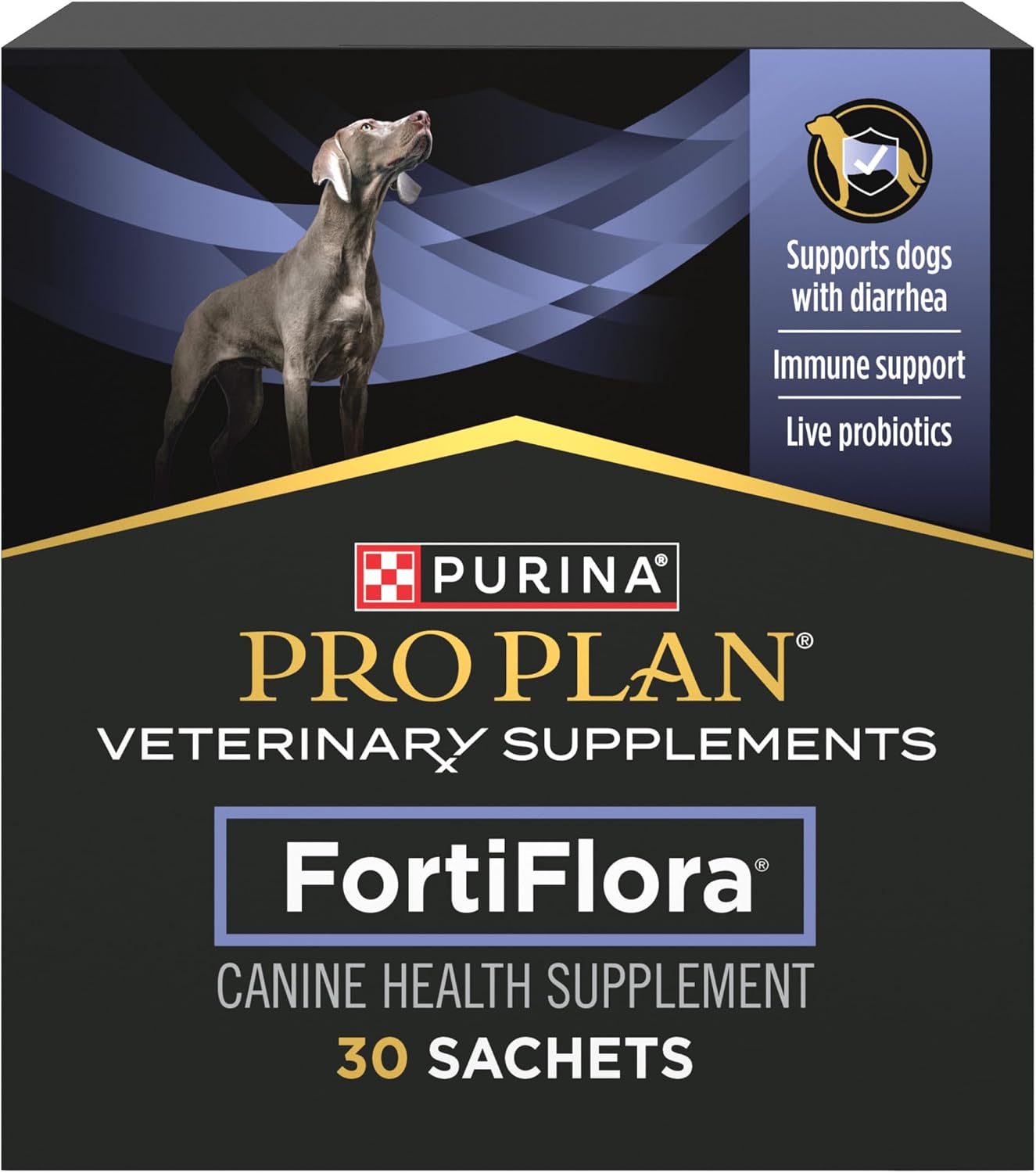
Pro Plan FortiFlora Probiotic Powder
Best Overall Probiotic for Dogs with Epi
| Item Form | Powder |
|---|---|
| Flavor | Unflavored |
| Active Ingredients | Enterococcus Faecium SF68 1×10^8 CFU |
| Specific Uses For Product | Digestive Health; Gastrointestinal; Probiotics |
Purina Pro Plan FortiFlora is a single-serve powdered probiotic intended to be sprinkled on a dog's food to support intestinal microflora and help manage occasional diarrhea. Each packet delivers a guaranteed level of Enterococcus faecium SF68 and uses microencapsulation to preserve probiotic viability until it reaches the gut, plus antioxidants to support immune health. It is simple to dose—feed one packet daily or follow your veterinarian's instructions—so administration is quick for both puppies and adult dogs. The powder form is easy to mix into wet or dry food and is unflavored, relying on included liver flavoring to encourage acceptance. Practical limitations include small packet size that means you'll need to buy in multi-count boxes for long-term use and that it is a targeted digestive aid rather than a comprehensive multi-supplement for other conditions. For pet owners wanting a vet-trusted, easy-to-use probiotic focused on digestive balance, FortiFlora is a reliable, straightforward option.
Best for: Buyers who want a vet-endorsed, easy-to-dose probiotic to manage occasional digestive upsets and prioritize proven effectiveness and straightforward administration.
Less Ideal for: Owners seeking a broader daily multivitamin or joint-and-digestive combination supplement should consider products formulated for multiple concerns rather than a single-purpose probiotic.
- Veterinarian-recommended strain proven to promote normal intestinal microflora
- Microencapsulation for probiotic stability through the digestive tract
- Single-serve powder that is easy to sprinkle on food and simple to dose
- Formulated for both puppies and adult dogs and intended for occasional diarrhea management
- Small unit count per package requires frequent repurchasing for ongoing use
- Focused specifically on digestive support and not a multi-purpose supplement
Verdict: The best overall probiotic for dogs with EPI that balances clinically relevant strains, adequate CFU counts, and reliable delivery to support digestion and stool consistency.
SnazFirst Probiotics for Dogs
Best Budget Probiotic for Dogs with Epi

| Form | Soft chews |
|---|---|
| Count | 150 chews |
| Target | Dogs (all life stages) |
| Active strains | 5 probiotic strains |
These SnazFirst probiotic chews deliver a multi-strain formula in a soft, chicken-flavored chew that makes daily dosing simple. Intended for day-to-day digestive support, the product is typically given as a treat to help rebalance gut flora, firm loose stool, soften hard stool, and reduce symptoms linked to food sensitivities such as itchy skin and ears. The formula highlights five active probiotic strains plus prebiotic ingredients like inulin and pumpkin to support nutrient absorption and immune health. A practical benefit is the large bottle size—150 chews—so households needing long-term maintenance can buy less often. The chews are positioned as gentle enough for puppies, seniors, and sensitive stomachs and avoid artificial colors and preservatives. Limitations: the listing does not provide CFU counts or strain-by-strain dosing, which makes comparing potency to veterinary products harder, and specific clinical claims are not evaluated by regulators. For owners wanting an affordable, easy-to-administer probiotic chew for routine support, this is a straightforward option; those seeking precise clinical dosing or veterinarian-prescribed products should look elsewhere.
Best for: Owners who prioritize straightforward, daily digestive support at an entry-level cost and prefer an easy-to-administer chewable supplement their dog will accept.
Less Ideal for: Pet owners who need veterinarian-prescribed formulations or exact CFU/strain dosing for medical conditions should consider clinical or prescription options instead.
- Soft, chicken-flavored chews that dogs readily accept
- Contains five probiotic strains plus prebiotic ingredients for gut support
- Formulated for all life stages including puppies and seniors
- Large 150-count bottle suitable for long-term maintenance
- No artificial colors, flavors, or preservatives listed
- Product listing does not state total CFU or detailed strain amounts
- Clinical claims are not evaluated by regulatory authorities
Verdict: The best budget probiotic for dogs with EPI that provides core beneficial strains and reasonable potency at a wallet-friendly price for routine use.
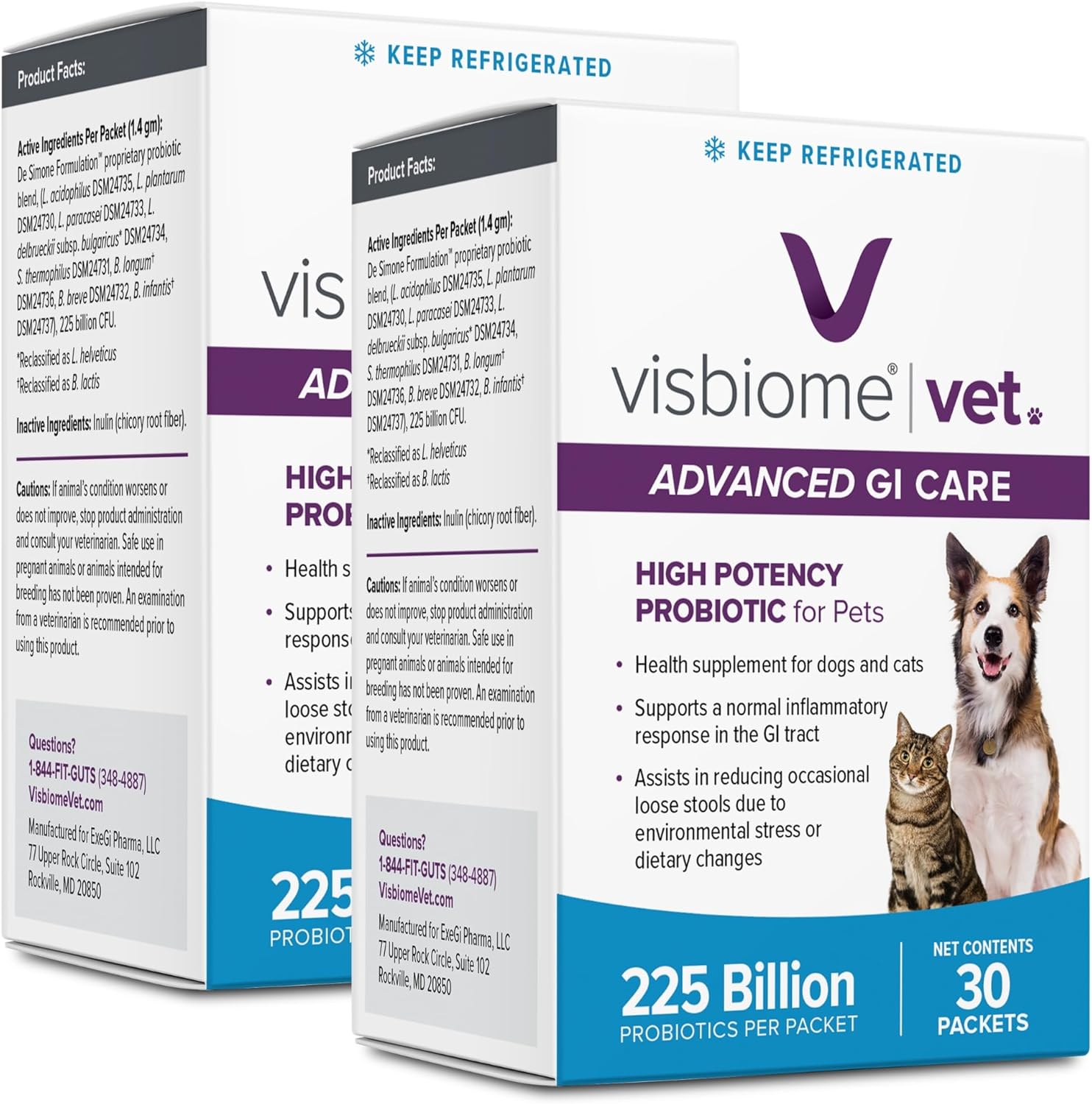
Visbiome Vet Probiotic 60 ct
Best High-Potency Probiotic
| Unit Count | 60 Count |
|---|---|
| Item Form | Powder |
| Flavor | Unflavored |
| Specific Uses For Product | Stomach |
Visbiome Vet is a refrigerated, single-serve probiotic powder designed to deliver very high colony-forming units for dogs and cats using the De Simone 8-strain formulation. Each packet supplies 225 billion live bacteria intended to support gastrointestinal health, reduce occasional loose stools from stress or diet changes, and assist in maintaining normal digestive resilience. It is given daily with weight-based dosing printed on the package so owners can adjust servings for small to large dogs. The product emphasizes cold-chain handling and is shipped with icepacks to preserve potency, and the single-serve packets make dosing and mixing into food easy. Clinical backing and third-party purity testing are notable pluses for owners managing serious gut issues. The main practical drawbacks are the requirement for refrigerated storage to maintain maximum potency and the higher potency focus, which means you should follow veterinary guidance—especially for dogs with sensitive conditions like EPI—to determine appropriate dosing and timing relative to enzyme replacement therapy.
Best for: Owners whose priority is rebuilding gut flora and improving nutrient absorption in dogs with serious GI issues and who will work with their veterinarian on dosing and refrigerated handling.
Less Ideal for: Owners who cannot reliably refrigerate supplements or who need a low-potency, room-stable probiotic for casual daily maintenance.
- Extremely high potency at 225 billion CFU per packet for aggressive recolonization
- Veterinary-recommended De Simone 8-strain formulation with clinical research support
- Single-serve powder packets simplify accurate dosing and mixing into meals
- Clean Label Project tested and NASC quality seal indicating impurity screening and minimal inactive ingredients
- Cold-chain shipping and storage to help preserve live bacteria until use
- Requires refrigerated storage and cold shipping to maintain maximum potency
- High CFU count may require veterinary dosing adjustments for dogs on enzyme replacement or with severe sensitivities
Verdict: The best high-potency probiotic for dogs that require elevated colony-forming units to help rebuild gut flora and improve nutrient absorption.
Nutramax Proviable Digestive Health Kit
Best Multi-Strain Probiotic

| Item Form | Capsule, Paste |
|---|---|
| Active Ingredients | kaolin, pectin, prebiotics |
| Volume | 30 ml |
| Guaranteed CFU per capsule | 5 billion CFU per capsule |
Proviable pairs multi-strain probiotic capsules with a small paste syringe to address both ongoing gut balance and short-term diarrhea. The capsules deliver seven bacterial strains and billions of CFUs plus prebiotics so you can sprinkle them over food daily for maintenance, while the tasty paste contains kaolin and pectin to coat and help firm loose stool during acute episodes. Typical use is a short paste course for 48 to 72 hours alongside daily capsules until finished, with clear dosing directions by weight. Clinically researched strains and a veterinarian-backed manufacturer make this an easy option for owners who want a science-supported daily probiotic that also tackles transient digestive upset. Limitations are the relatively small kit count (one 30 mL paste and ten capsules) so this will not cover long-term daily dosing for larger dogs without purchasing larger packs, and the paste dosing requires multiple daily administrations for best effect.
Best for: Owners who want a single product that combines daily multi-strain probiotic support with a short-course diarrhea paste for occasional GI upsets, and who value clinician-backed formulations.
Less Ideal for: Households seeking a long-term daily supply for large or multiple dogs without buying larger-count packs, or those who need a paste-free administration route exclusively.
- Multi-strain formula with seven specified bacterial strains for broader gut support
- Includes prebiotics to encourage probiotic growth in the intestine
- Dual-format kit: sprinkleable capsules for daily use plus a paste for short-term diarrhea support
- Clinically researched and veterinarian-recommended brand background
- Capsules are easy to administer by sprinkling over food
- Kit contains only a 30 mL paste and ten capsules, so not sufficient for prolonged daily use for larger dogs
- Paste requires multiple daily oral administrations which can be messy or require restraint
Verdict: The best multi-strain probiotic for owners who want a broad-spectrum formulation that targets multiple aspects of digestive health and microbial balance.
Zesty Paws Probiotics for Dogs 90 Ct
Best Shelf-Stable Probiotic

| Item Form | Soft Chew |
|---|---|
| Flavor | Chicken – Probiotic |
| Unit Count | 90 Count |
| Active Ingredients | Prebiotics & Probiotics, glycerin, pumpkin |
| Specific Uses For Product | Stomach |
Zesty Paws Probiotics for Dogs are soft chew supplements designed to be given as daily, treat-like doses to support digestion and regular stools. Each suggested serving delivers a Gut First Blend of three strains (Bacillus coagulans, Bacillus subtilis and Saccharomyces boulardii) plus FOS prebiotic and pumpkin, making the chews useful for gas, occasional diarrhea and general gut balance. The chicken-flavored soft chews are easy to hand-feed or mix into food, which helps with dogs that refuse pills. Directions allow gradual ramp-up from half the suggested amount and scale by weight, so you can adjust for puppies through large adults. Practical limitations include potential for loose stools in sensitive dogs at high doses and a lack of explicit per-chew CFU listing on the label text shown here (CFU quoted per two chews in marketing), so careful dosing is needed. Made in the USA and packaged as a 90-count tub, these chews are best used as a daily maintenance supplement or short-term support during stressors like travel or boarding.
Best for: Buyers who need a palatable, chewable probiotic for dogs that resist pills and want a daily, treat-like supplement to support digestion during travel, diet changes, or routine maintenance.
Less Ideal for: Owners seeking a probiotic with exact per-chew CFU labeling or veterinarians needing clinical-strength, prescription-level probiotic formulations should consider alternatives.
- Treat-like soft chews that are easy to hand-feed or hide in food for dogs that refuse pills
- Contains a three-strain probiotic blend including a yeast probiotic plus FOS prebiotic for gut support
- Includes pumpkin and other ingredients aimed at normalizing stools and supporting digestion
- Clear weight-based dosing guidance allowing use from puppies to large dogs
- Made in the USA and offered in a 90-count tub for regular daily use
- Marketing lists CFU per two chews rather than per single chew which complicates precise dosing
- High doses may cause diarrhea or loose stools in sensitive animals
Verdict: The best shelf-stable probiotic for pet owners who need a formulation that retains potency without refrigeration for convenient everyday use or travel.
Vetoquinol Pro-Pectalin Chewable Tablets 60ct
Best Veterinarian-Formulated Probiotic

| Item Form | Freeze-Dried Chew |
|---|---|
| Active Ingredients | Kaolin 1.00 g; Pectin 0.05 g; Enterococcus faecium 0.6 Billion CFU per tablet |
| Flavor | Other |
| Product Benefits | Supports digestive health and stool firmness |
Vetoquinol Pro-Pectalin is an oral chewable supplement aimed at short-term digestive support and occasional loose stool in dogs and cats. Each tablet combines kaolin and pectin to absorb excess water and soothe irritated intestines while a single direct-fed microbial strain, Enterococcus faecium, helps restore normal intestinal flora. The beef liver flavor and chewable freeze-dried form make administration straightforward either given whole or crumbled into food, which is useful during travel, diet changes, or mild gastrointestinal upset. Practical benefits include fast-acting stool firming and a simple single-strain probiotic profile that appeals to owners who prefer targeted bacterial therapy with clearer strain identity. Limitations are that it is positioned for situational use rather than as a multi-strain daily maintenance probiotic and the label advises veterinary consultation for persistent or severe conditions. It also does not replace veterinary diagnostics or therapy when underlying disease is suspected.
Best for: Pet owners who want a targeted, single-strain probiotic to address occasional loose stool or short-term GI upset and who prioritize clear strain identity over multi-strain formulas.
Less Ideal for: Owners seeking an all-day maintenance multi-strain probiotic for chronic gut issues or pets requiring vet-prescribed therapeutic interventions should consider other options.
- Single identified probiotic strain (Enterococcus faecium) for targeted gut support
- Kaolin and pectin combination absorbs excess water and helps firm stool
- Beef liver flavored chewable form that can be given whole or crumbled into food
- Formulation intended for quick relief during occasional loose stool episodes
- Designed for short-term or situational use rather than a broad-spectrum daily probiotic
- Not a replacement for veterinary diagnosis or treatment of persistent digestive disorders
Verdict: The best veterinarian-formulated probiotic for owners seeking a product developed with veterinary input and evidence-based strain selection for clinical digestive concerns.
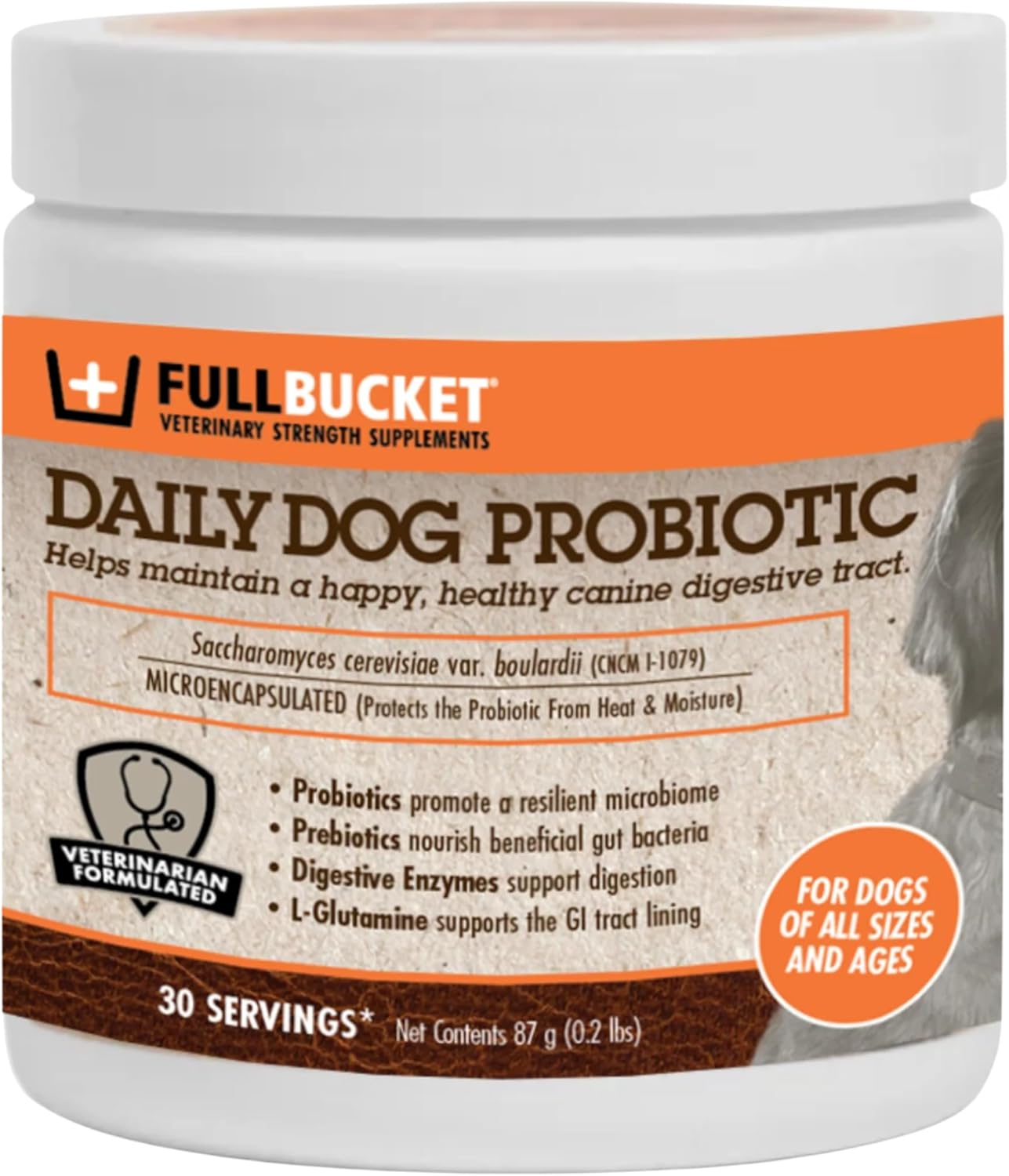
FullBucket Daily Dog Probiotic 30 Servings
Best Easy-Dose Probiotic
| Form | Powder |
|---|---|
| Active Ingredients | prebiotics |
| Item Form | Powder |
| Servings | 30 |
FullBucket Daily Dog Probiotic is a sprinkle-on powder that combines Saccharomyces boulardii probiotics, prebiotic yeast extract, L-glutamine and multiple digestive enzymes to support gut recovery and regular digestion. You add the measured scoop to your dog's meal once daily, so dosing is fast and unobtrusive for dogs that accept food-topplers. Microencapsulation is advertised to help probiotic organisms survive saliva and stomach acid, and the included prebiotic helps feed good bacteria while enzymes aid breakdown of nutrients. Practical benefits include an easy mealtime workflow, formulas that target acute loose stools and ongoing gut support, and a flavor profile most dogs tolerate. Limitations are that this is a powder only, so it is not suitable if you need chewables or single-serve packets for travel, and owners should follow weight-based serving directions and consult a veterinarian for dogs with chronic conditions like exocrine pancreatic insufficiency or complex EPI management where enzyme dosing must be precise.
Best for: Owners who want a simple, once-daily sprinkle that can be mixed into regular meals to maintain consistent probiotic dosing without extra treats or pills.
Less Ideal for: Buyers who need single-serve packets, chewable formats, or precise prescription enzyme dosing for complex digestive disorders should look elsewhere or consult their vet.
- Powder form mixes into food for quick, stress-free daily dosing
- Contains Saccharomyces boulardii plus prebiotics and digestive enzymes for multi-pronged gut support
- Microencapsulation helps probiotics survive stomach acid to reach the gut
- Veterinarian-developed formulation aimed at preventing and treating loose stools
- Only available as a powder so not ideal if you need chewable treats or single-dose packets for outings
- Not a replacement for prescription enzyme regimens required by some medical conditions
Verdict: The best easy-dose probiotic for owners who prioritize straightforward administration—chews, sprinkle powders, or single-serve packets—that ensure consistent daily dosing for dogs.
Choosing the Right Probiotic Dog Epi: Key Factors to Consider
Strain Composition and Evidence
Not all probiotics are the same. Look for products that list specific strains rather than generic species-level claims. Certain strains have more evidence for supporting intestinal barrier integrity, modulation of inflammation, and enhancement of short-chain fatty acid production, all of which matter for dogs with EPI.
Strain-level transparency lets you check whether a strain has been studied in dogs or in physiologically similar mammals. When evidence in dogs is limited, prefer strains with plausible mechanisms for improving digestion or reducing small intestinal bacterial overgrowth, and those with safety data in companion animals.
Delivery Format and Stability
Probiotics come as powders, chewables, capsules, and microencapsulated powders. For dogs with EPI you want a format that stays stable when mixed with food and when given alongside pancreatic enzymes. Powdered or microencapsulated forms often mix easily into meals and may be less likely to get rejected by picky eaters.
Consider shelf stability and whether refrigeration is required. Products that maintain viability at room temperature reduce the risk of degraded potency when stored or transported. Also check packaging that protects from moisture and light to preserve live organisms.
Compatibility with Enzyme Therapy
Dogs with EPI commonly take pancreatic enzyme replacement at meals. The probiotic you choose should be easy to coordinate with that regimen. Some formulations can be sprinkled into food at the same time as enzymes without reducing enzyme activity or probiotic viability.
Ask whether the manufacturer provides guidance on co-administration and whether the format allows accurate simultaneous dosing. Avoid products that must be given hours apart if that makes feeding schedules impractical for you and stressful for your dog.
Dose Accuracy and Ease of Administration
Accurate dosing matters because underdosing may provide no benefit and overdosing can increase cost or cause minor digestive upset. Look for products with simple measuring systems, single-serve sachets, or chewables sized for your dog's weight.
Ease of administration affects adherence. If your dog is a picky eater or on a strict enzyme schedule, choose a palatable format that mixes well into food or is accepted as a treat. Clear dosing instructions by weight or by veterinary guidance make day-to-day use simpler.
Ingredient Profile and Potential Irritants
Dogs with EPI can be sensitive to fillers or high-fat carriers that may worsen stool consistency. Review ingredient lists for unnecessary additives, artificial colors, or high-fat matrixes that could conflict with the low-to-moderate fat diets often recommended for EPI management.
Prefer products with short, transparent ingredient lists and minimal allergenic components if your dog has known food sensitivities. Fiber type also matters; some prebiotic fibers can help produce beneficial short-chain fatty acids, while others may increase gas or loose stool in sensitive animals.
Manufacturer Transparency and Supporting Documentation
Good documentation makes it easier to evaluate a probiotic's suitability. Look for clear labeling of strains and counts, storage instructions, and any available third-party testing or quality-control statements.
Technical resources such as white papers, stability data, or veterinarian-facing guidance indicate a manufacturer that understands the needs of dogs with chronic digestive conditions. Avoid products that fail to provide basic details about how potency is measured and guaranteed through the product's shelf life.
How Soon Can You Expect to See Changes in Stool and Appetite?
Timing varies depending on the dog and the specific probiotic used. Many owners report subtle improvements in stool consistency and reduced variability within one to three weeks, while other changes such as improved appetite or reduced gas may take longer.
Consistency of dosing and pairing with an appropriate enzyme replacement and diet are important. If you do not see any improvement after a month of consistent use, re-evaluating strain choice, dose, or dietary factors with your veterinarian is reasonable.
- Initial changes often appear within 7 to 21 days.
- Full effects on gut microbiota and nutrient absorption can take several weeks.
- Lack of response after 4 weeks warrants veterinary reassessment.
Can Probiotics Be Given at the Same Time as Pancreatic Enzymes?
Many probiotic formats are safe to give with pancreatic enzymes, but the exact instructions depend on product stability and manufacturer guidance. Powders that mix into meals are commonly co-administered with enzymes without special timing adjustments.
If you are unsure, follow the product's directions and your veterinarian's advice. Maintaining a consistent routine is typically more important than minor timing differences, provided the probiotic is not heat-treated or otherwise likely to be inactivated by the method you use.
- Read dosing instructions for co-administration guidance.
- Maintain a consistent administration routine to help assess effectiveness.
What Form of Probiotic Is Easiest for Dogs with Poor Appetite?
For dogs that eat slowly or have low appetite, highly palatable chewables or single-serve flavored powders can be easier to administer. Powders that blend into a small amount of food or a favorite topper let you deliver both enzymes and probiotic in one spoonful.
If your dog will not accept treats, consider microdosing into meals or using veterinarian-recommended palatants. The simpler the routine, the more consistent you will be with dosing, and consistency is a key driver of benefit.
- Chewables work well for food-motivated dogs.
- Powders are flexible for mixing with small meals.
- Single-dose sachets help prevent dosing errors.
Managing Side Effects or Initial Digestive Upset
Mild, temporary increases in gas or loose stool can occur when starting a probiotic as the microbiome adjusts. These effects usually resolve within a week or two. If side effects are severe or persist, stop the product and consult your veterinarian.
If your dog is on multiple gastrointestinal therapies, introduce the probiotic gradually when possible. Monitor hydration and stool frequency closely, and keep your veterinarian informed if you notice worsening signs.
- Expect mild transient changes within the first 7–14 days.
- Severe or prolonged upset requires veterinary evaluation.
- Introduce new supplements one at a time when possible.
How to Pick a Probiotic when Your Dog Is on Multiple Medications
Coordinate dosing schedules to minimize disruption and consult your veterinarian about potential interactions. Most probiotics do not interact directly with common medications, but complex treatment plans for EPI may benefit from professional review to avoid overlapping side effects or digestive overload.
Provide your vet with ingredient lists and dosing schedules so they can advise on compatibility. Prioritize products that are simple to add to meals and do not require separate administration windows that complicate an already busy routine.
- Share full medication and supplement lists with your veterinarian.
- Choose easy-to-administer formats to reduce missed doses.
Signs That a Probiotic Is Working for a Dog with EPI
Look for more consistent stool form, fewer episodes of soft or watery stool, more predictable bowel movements, and a gradual improvement in weight stabilization or appetite. These clinical improvements suggest better digestion and microbial balance.
Also monitor for less gas, reduced abdominal discomfort, and an overall increase in energy. Documenting changes with a simple stool log and weight checks helps you and your veterinarian determine whether the probiotic is contributing to improvement.
- Improved stool consistency and reduced variability.
- Stabilized appetite and gradual weight maintenance.
- Reduced gas and fewer gastrointestinal upsets.
How We Chose the Best Probiotic Dog Epi
We prioritized products that address the specific digestive challenges of dogs with EPI, using criteria that reflect everyday use and measurable gut-health benefits. Key evaluation points included strain composition and evidence of gastrointestinal benefit in canines or closely related mammalian models; delivery format and stability when used alongside pancreatic enzyme replacement; viability claims and shelf-life under normal storage; dosing precision and ease of administration for owners managing multiple daily treatments; and ingredient transparency, including absence of common gut irritants. We excluded products that lacked clear strain labeling, provided only generic colony counts without strain identification, or used delivery forms incompatible with typical enzyme dosing schedules. Our selection favored formulas with strains known to support intestinal barrier function and short-chain fatty acid production, practical packaging for multi-dose regimens, and clear manufacturer guidance on co-administration with enzymes. The resulting shortlist represents options likely to be safe and manageable for most dogs receiving standard EPI therapy.
Our full evaluation process is outlined in our review methodology.
FAQ
Are human probiotics okay for dogs with EPI?
Some human probiotics contain strains that are safe for dogs, but formulation, dosage, and excipients may differ. Consult your veterinarian before using human products because veterinary guidance helps ensure the strain, dose, and delivery form are appropriate for a dog with EPI.
How long should a dog with EPI stay on a probiotic?
Many dogs remain on probiotics long term as part of a comprehensive digestive care plan, but duration depends on clinical response. Reassess with your veterinarian periodically to confirm continued benefit and to adjust strains or doses if clinical signs change.
Can probiotics reduce the need for pancreatic enzyme adjustments?
Probiotics may improve stool consistency and digestion, which can make enzyme dosing easier to manage, but they are not a substitute for pancreatic enzyme therapy. Any enzyme adjustments should be made under veterinary supervision based on clinical signs and weight trends.
Do probiotics interfere with diagnostic tests for EPI?
Probiotics generally do not interfere with standard blood tests used to diagnose EPI. If you have upcoming diagnostics, mention all supplements to your veterinarian so they can advise whether temporary discontinuation is advisable for specific tests.
What if my dog refuses flavored probiotic chews?
If flavored chews are refused, try powdered formats that can be mixed with a small, highly palatable portion of food or a favorite topper. Single-serve sachets or small measured scoops help ensure accurate dosing without relying on voluntary consumption of a treat.
Final Verdict
Focus on strains, delivery format, and compatibility with enzyme therapy when choosing a probiotic for a dog with EPI. Prioritize products with clear strain labeling, easy dosing that fits your feeding routine, and ingredients that avoid unnecessary irritants. Monitor stool consistency, appetite, and weight after starting a probiotic and work with your veterinarian to interpret results. With the right tradeoffs—stability versus palatability, and evidence versus convenience—you can select a probiotic that supports digestive stability and complements ongoing EPI treatment.

